You or someone using this computer or device previously created Trip Plans.
What should we do with these plans?
Login
Some text here
Password Reset
Please enter the email you used to set up your account.
We'll send a link to use to reset your password.
Check Your Email
If there is an account with the email address , we will send you a link to reset your password
Southeastern Utah Weekend Trip: Bluff International Balloon Festival
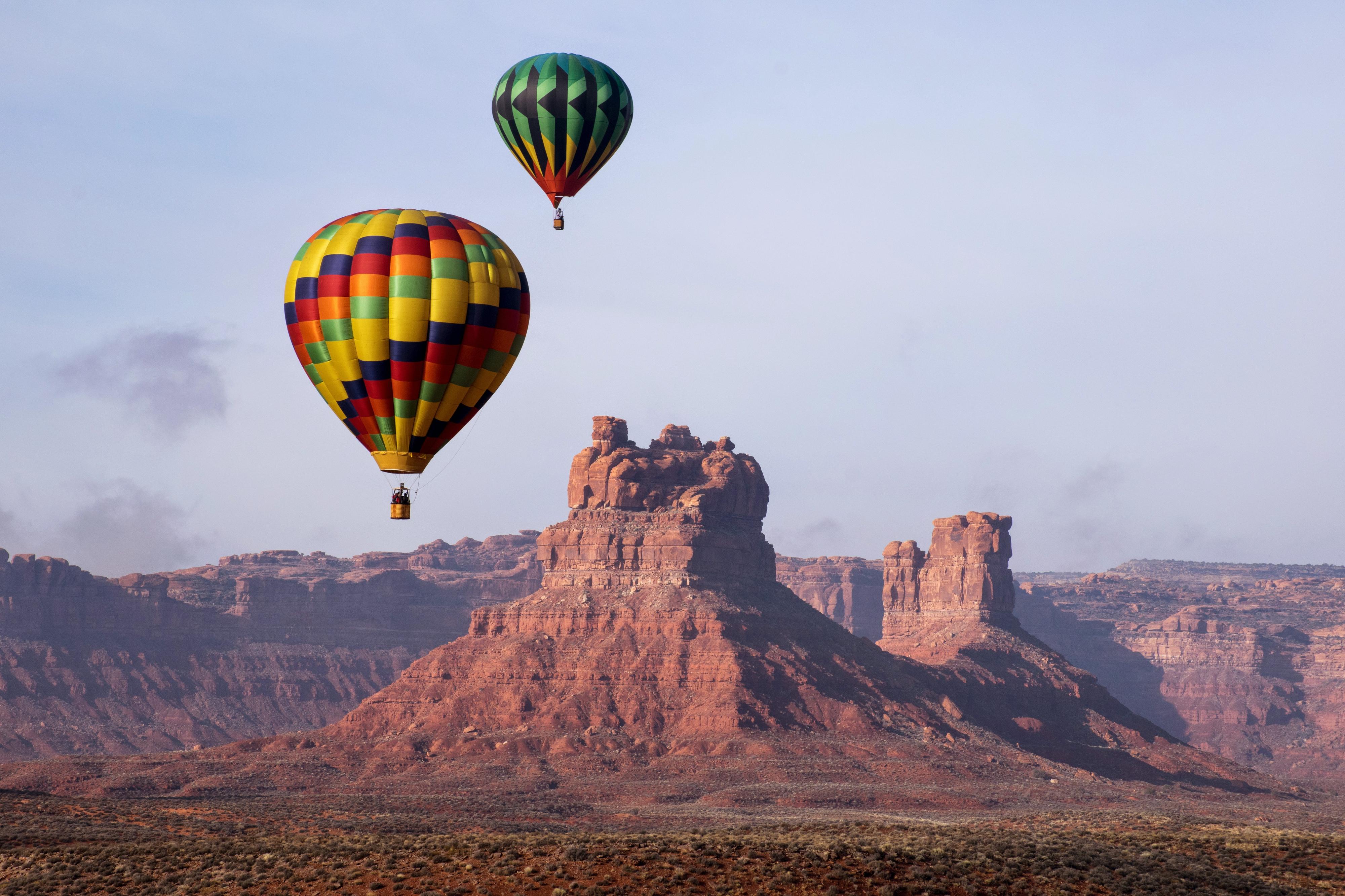
The 25th Annual Bluff International Balloon Festival is right around the corner, coming up on January 12th-14th 2024. If you’ve attended the festival in the past, you will be familiar with the schedule which includes three days of balloons taking to the skies. Balloons will fly over Bluff the mornings of January 12th & 13th, and over Valley of the Gods the morning of the 14th. (weather permitting)
In addition to the morning balloon flights each day of the festival, the always popular Glow-in will take place on Saturday evening from 5:00-7:00pm. This event allows spectators to get up close to the balloons, which inflate but remain tethered on the ground, and intermittently light up as their burners are fired. Adding to the ambiance of this unique event, local musician, Neon Nativez, has been joining the festival for the past several years playing live music at the Glow-in. Neon Nativez’s music is a blend of Electronic Dance music incorporating Navajo drumming, singing, etc The combination of glowing hot air balloons and Neon Nativez’ unique music has become a favorite event at the Bluff Balloon Festival!
Another favorite event is the Artist Market from 10:00am- 6:00pm on Saturday the 13th. Local and regional artists set up booths in the community center to sell their wares, and it’s a great chance for visitors to find a one of a kind piece of San Juan County to take home with them.
If you’ve been to the area before, you’re already well aware that there are endless things to see and do in Southeastern Utah. While a weekend visit will only allow first-time visitors to begin to scratch the surface of everything Utah’s Canyon Country has to offer, we thought we’d share our suggestions of how to get the most out of your weekend in Utah’s Canyon Country.
During the winter months you will have fewer options on guided tours than during the summer, but we have some amazing local guides who operate year-round and are here to help make your visit memorable.
For guided hikes with indigenous interpretations, check out Ancient Wayves River & Hiking Adventures. Their team of indigenous guides are passionate about sharing their culture with visitors, and offer a unique and authentic introduction to Bears Ears National Monument and the surrounding area that visitors will not be able to experience when visiting on their own.
If you’re looking for more of a heart pounding experience to get your adrenaline going, Sunrise Outfitting Scenic Tours offers guided OHV tours throughout the region. One of our favorite tours they offer is the Arch Canyon ride which is the perfect combination of amazing scenery, archaeological sites, and an exciting OHV ride! If you’ve never been to Arch Canyon, you will be shocked at the beauty as you make your way up the canyon with frequent stops to view archaeological sites high in the canyon walls.
For those looking for a relaxing vehicle tour, Wild Expeditions offers a couple different options including our recommendation, a Sunset Tour of Valley of the Gods. Valley of the Gods, which is sometimes referred to as a ‘miniature’ Monument Valley, is a hidden gem, which gets far less visitation than its more well-known counterpart. Less visitation means more solitude, so if you’re looking for a place with amazing scenery, and you want to get off the beaten path, Valley of the Gods is the perfect location! Sit back and enjoy the non-stop views while Wild Expeditions’ expert guides lead you through the area!
Explore on your Own
The list of places that can easily be visited on short day trips from Bluff is endless. Here’s a list of some of our favorites to get you started:
Your visit to Bluff is not complete without a stop at the Bluff Fort—a free museum & visitor center with replica cabins and buildings telling the story of the Mormon pioneers who settled there in 1880. Be sure to check out the Co-op store for area information, gifts & souvenirs, and delicious, homemade baked goods and soft-serve ice cream!
View this easily-accessible rock art panel with images ranging from 800 to 2,500 years old. Images represented on the panel include Kokopelli, the humpbacked flute player of ancient Pueblo mythology. Picnic areas, camp sites, and a boat ramp are also provided at Sand Island.
Often described as a ‘miniature’ version of Monument Valley, Valley of the Gods is arguably, equally spectacular. What Valley of the Gods may lack when it comes to the size and volume of its free standing monoliths, spires, and fins, it makes up for with solitude. It would be a rare occurrence to pass through Monument Valley without seeing another visitor, but at Valley of the Gods, you’re likely to have the whole place to yourself to explore and enjoy!
This breathtaking overlook on the San Juan River highlights the largest entrenched river meander in North America. From the overlook, visitors can see where the river twists and turns through the ‘goosenecks’ as it flows toward Lake Powell, traveling over 6 miles while advancing west just 1 mile.
Constructed in the 1950s to transport uranium, the Moki Dugway is an unpaved, 3-mile (4.83 km) section of Hwy 261 comprised of switchbacks carved into the face of the cliff edge. The road, which can be treacherous in rain or snow, winds 1,200 feet (365.76 m) from Cedar Mesa to the valley floor near Valley of the Gods. Not for the faint of heart (or those with a fear of heights), this route provides breathtaking views of some of Utah’s most beautiful landscapes, such as Monument Valley and Valley of the Gods.
Muley Point Overlook has sweeping vistas to the south and includes clear views of the canyons below at sunrise and sunset. From your high vantage point, you’ll see canyons unfolding all the way to Monument Valley. You’ll also lay eyes on the entrenched meanders of the San Juan River.
Natural Bridges National Monument was designated Utah’s first National Monument in 1908. At Natural Bridges, visitors can view three natural bridges (Kachina, Owachomo, and Sipapu) from overlooks along Bridge View Drive, a paved 9-mile loop road, or by short hikes from each trailhead. For those who are looking for a longer hike, an 8.6-mile loop trail will take you past and/or under all three bridges. Ranger-led Dark Sky Astronomy Programs are offered spring through fall.
Mule Canyon is another Ancestral Puebloan ruin, located along Hwy 95. This site includes above ground and underground dwellings including a kiva and a tower which have been stabilized.
House on Fire Ruin is the first archaeological site located along the trail in the South Fork of Mule Canyon. To capture the picturesque flames above the house, it’s best to do this hike in the late morning when the light reflects off the opposite wall of the canyon. Continuing past House on Fire, several additional archaeological sites can be seen. Some are easily accessible and others can be viewed from the trail as they are nestled high in the canyon walls. The trailhead for this hike is located on County Road 263 near mile marker 102.
With a total of seven towers along the rim of Mule Canyon, Cave Towers is the perfect family hike. Some towers are slightly more than piles of rocks, but one tower still has a large section of wall standing with a doorway intact. These impressive Ancestral Puebloan sites are fragile remains perfect for historical exploration as well as viewing various structures in alcoves and overhangs in the canyon walls. Leashed dogs allowed on the trail.
A spectacular cliff dwelling located on the east side of Comb Ridge, which was built and occupied by the Ancestral Puebloans around 1200 A.D. While parts of the site have been stabilized and reconstructed, most of it is still how it was found in the 1800s. The site includes habitation, storage, and ceremonial structures, including four kivas. The trail to the overlook is 1 mile round trip and takes approximately .5 hrs.
This world-class museum is a hidden gem in the Four Corners Region. As a federal, archeological repository, the museum is home to one of the largest and most comprehensive collections of Ancestral Puebloan artifacts in the Four Corners Region. It’s also home of Edge of the Cedars Pueblo, a one-thousand-year-old Puebloan village site, which is located behind the museum.
Shop Local
And of course no trip is complete without a little shopping! While we don’t have any malls, box stores, or chain retailers in the area, we have something far better- locally owned and operated trading posts and gift shops selling local and regionally made items!
With an area of 7,933 sq. miles (larger than Rhode Island, Delaware, or Connecticut) San Juan County is nearly the size of the state of New Jersey! As you can imagine, with a county that large, this list is only scratching the surface of everything there is to see and do in the area, and while this list is primarily focused on the Bluff area for those coming for the Bluff International Balloon Festival, it's full of day trip ideas that will keep all visitors busy for the long weekend!
If you have any questions while planning your visit, don't hesitate to reach out to us!